
Why You Should Consider Using VR Technology in Your Safety Training
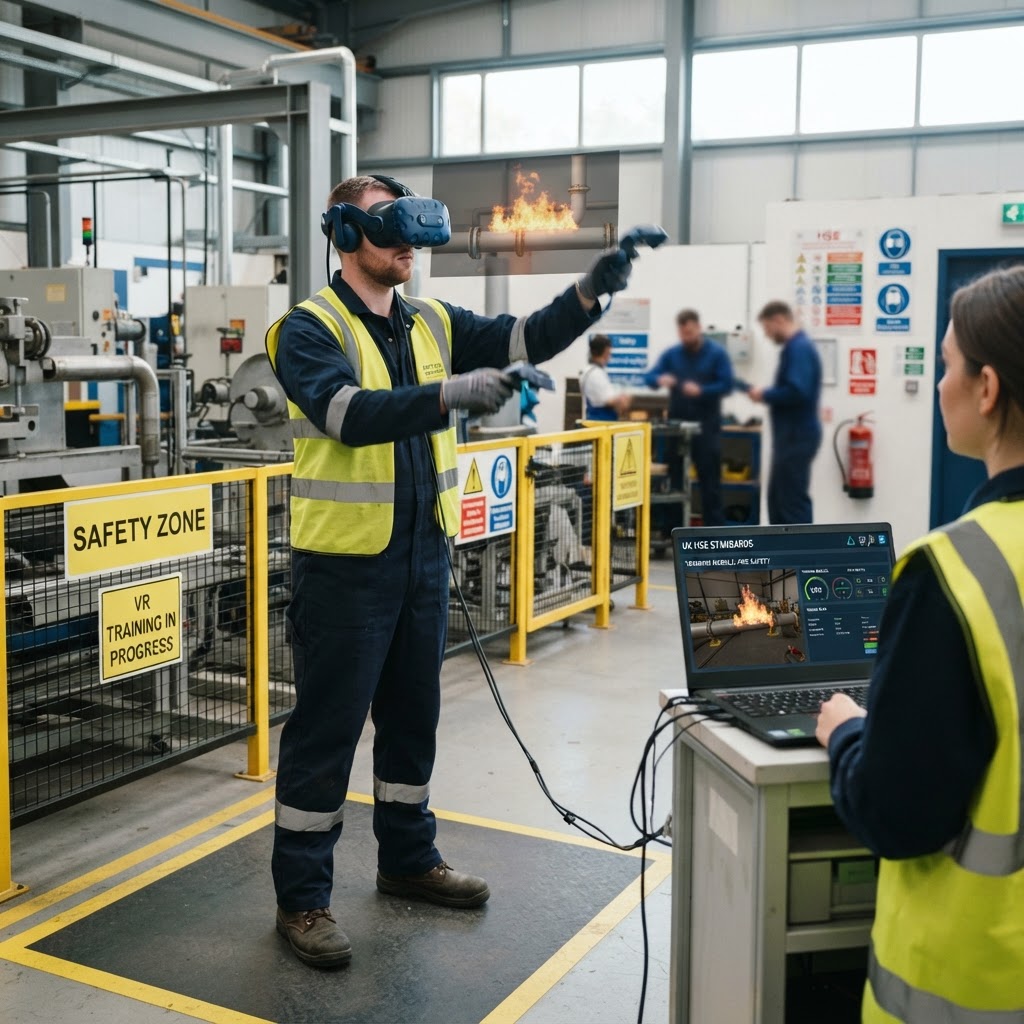
Workplace compliance training often gets an unfair reputation. Mention the annual fire marshal refresh or health and safety briefing, and you will likely hear collective sighs across the office. Traditional PowerPoint slideshows and tick-box questionnaires have long been the standard, but they rarely instil genuine confidence when emergencies arise.
Picture this: a fire breaks out in a commercial kitchen or a colleague collapses on the warehouse floor. In those initial high-stakes moments, will your staff remember bullet point number four on slide fifteen? Probably not.
At Comply Sense, we believe safety training should prepare people for real life, not just an audit. That is why immersive virtual reality is transforming workplace safety. Read on to discover why your organisation should consider integrating VR technology into your safety training strategy.
The Shortcomings of Traditional Compliance Training
For decades, organisations across the United Kingdom have relied on classroom lectures and demonstration videos to fulfil regulatory duties under the Health and Safety at Work etc. Act 1974 and the Regulatory Reform (Fire Safety) Order 2005.
While well-intentioned, these traditional formats face significant challenges:
- The Forgetting Curve: Research consistently reveals that learners forget up to 70% of newly acquired information within 24 hours if they do not actively apply it.
- Passive Disengagement: Listening to an instructor for hours rarely builds the emotional engagement or muscle memory required to act decisively.
- Operational Disruption: Organising live fire drills outside or coordinating multi-day off-site courses can disrupt business operations and incur substantial travel and venue costs.
- Environmental Impact: Discharging live fire extinguishers or running open-flame simulators burns fuel and releases unnecessary chemical agents into the atmosphere.
To ensure duty-holders meet their legal obligations and keep teams safe, training must evolve.
What Makes VR Safety Training So Effective?
Virtual reality bridges the gap between theoretical knowledge and practical action. By donning a headset, an employee steps out of a conference room and straight into a dynamic, 360-degree scenario that feels completely lifelike.
1. Hands-On Muscle Memory Without Physical Risk
True emergency response relies on instinctive behaviour. Immersive training lets staff experience high-risk situations in a zero-risk virtual environment. When learners put out simulated electrical blazes or assess hazards in a chaotic corridor, they build genuine muscle memory. They learn to pull the pin, assess the fire class, and sweep the nozzle correctly without being exposed to smoke, heat, or dangerous chemicals.
2. Unrivalled Knowledge Retention
Studies into immersive learning reveal that VR participants retain up to 75% more information compared to traditional classroom formats. Furthermore, learners can be trained up to four times faster. By engaging multiple sensory channels, the brain encodes the virtual drill as an authentic experience, cementing what to do when seconds count.
3. Immediate, Data-Driven Feedback
Unlike a passive lecture, VR does not let employees hide in the back row. Our systems track reaction times, extinguisher selection, evacuation routes, and decision-making accuracy. Instructors receive objective performance reports immediately, making it easy to debrief learners and identify specific knowledge gaps across departments.
Transforming Emergency Response: From Extinguishers to First Aid
Immersive technology is versatile, allowing organisations to replicate practically any workplace hazard.
Realistic VR Fire Training
With dedicated VR Fire Training, your appointed fire marshals and everyday team members can tackle complex fire emergencies across various simulated settings, including office floors, commercial kitchens, and industrial warehouses.
Using an interactive VR Fire Trainer, participants handle realistic extinguisher props—covering CO2, foam, dry powder, and modern water mist units. Trainees practice choosing the correct unit under pressure, such as avoiding water on an electrical panel fire, giving them the confidence to act swiftly should an alarm sound for real.
Actionable Safety Training: VR First Aid
Emergency medical situations can be equally daunting. When incorporating safety training VR First aid into your syllabus, employees enter realistic emergency simulations. Whether it is managing a casualty following a fall, assessing an unconscious colleague, or delivering effective chest compressions alongside automated external defibrillator (AED) prompts, virtual life support software trains individuals to stay calm, assess hazards, and administer critical care prior to the arrival of paramedics.
Practical Steps to Implement VR Training in Your UK Workplace
Making the transition to immersive learning is far simpler than many facility managers expect. You do not need a dedicated digital studio or an in-house IT specialist to get started.
- Identify High-Risk Roles and Gaps: Review your recent Fire Risk Assessments, accident books, and near-miss logs. Identify which teams—such as designated fire wardens, first aiders, or warehouse supervisors—would gain the most immediate value from hands-on simulation.
- Adopt a Blended Learning Approach: You do not need to discard your existing curriculum overnight. Combine essential classroom theory and discussions with virtual simulations to reinforce practical techniques.
- Assess Your Space: Dedicated VR safety sessions require minimal physical infrastructure—only a clear indoor room and standard electrical power. The training provider brings the calibrated headsets, extinguisher hardware, and software.
- Maintain Digital Audit Trails: Use performance summaries and digital sign-offs generated during simulations to support internal health and safety audits and satisfy Health and Safety Executive (HSE) inspectors.
Build a Confident, Prepared Workforce with Comply Sense
Compliance training should never be reduced to a tick-box exercise. By introducing immersive virtual reality into your health and safety programme, you protect your business, empower your team, and ensure that if an emergency occurs, your staff are truly prepared to respond.
Whether you are looking to purchase equipment like the VR Fire Trainer or want our experienced team to deliver certified, hands-on sessions at your facility, Comply Sense is here to help.
Ready to see virtual reality safety training in action? Get in touch with the Comply Sense team today to book an interactive demonstration!